Sub-Total: $0.00
Introduction
Intelligent Concrete, LLC is pleased to present this report of our evaluation and observations performed on concrete cores that were shipped to our laboratory under chain of custody. It is our understanding the two cores submitted for evaluation and observations are from two different overlay and concrete substrate decks a conventional system (REFERENCE, REF) and the system with EDYSTON (DENSYGEL) applied between the substrate and overlay. It should be noted that both the concrete decks and accompanying concrete overlays evaluated were the same age when the overlay was placed and the cores extracted.
Cores and Methods
The concrete cores submitted for evaluation and observation:
| Core Number | Laboratory ID | Description of the Core |
| SR | REFERENCE | From the Concrete Overlay Prepped and Grooved without DENSYGEL |
| 4-9 | DENSYGEL | From the Concrete Overlay Prepped and Grooved with DENSYGEL |
The concrete cores were placed in a compression-vice and then cored through the overlay into the concrete substrate. The sample surface was then prepared, cleaned and dried to receive a dolly for ASTM C 1583, Concrete Bond Strength.
Two key tests that play a crucial role in this evaluation are ASTM C 1583 bond strength and a microscopic evaluation of the concrete interfacial zone between the concrete substrate and overlay.
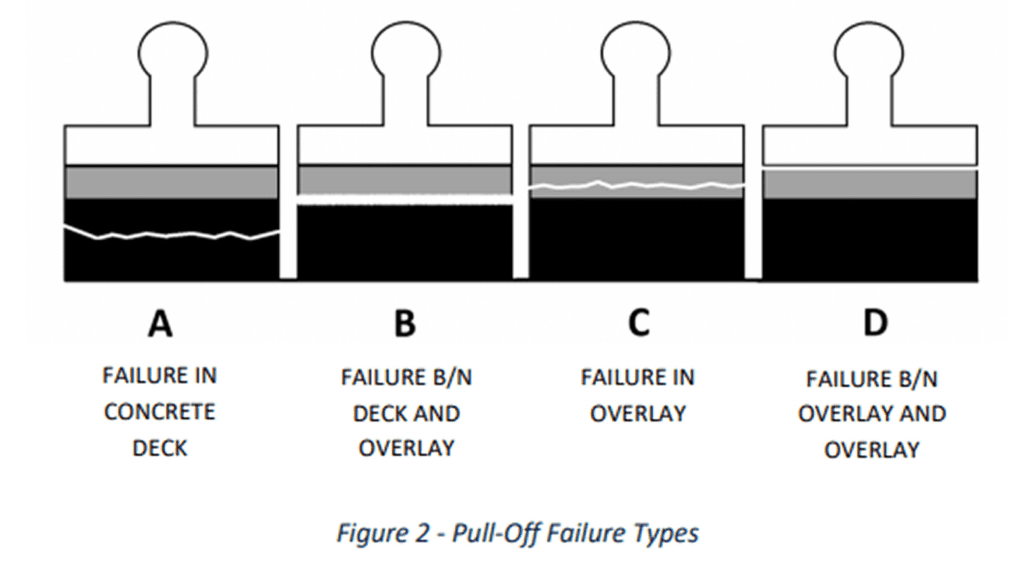
ASTM C 1583, concrete bond strength helped evaluate the strength and resiliency of the bond between the overlay and substrate. It evaluates the bond strength by measuring the force required to separate the overlay from the substrate, providing valuable insights into the overall performance of the overlay system by identification of the type and location.
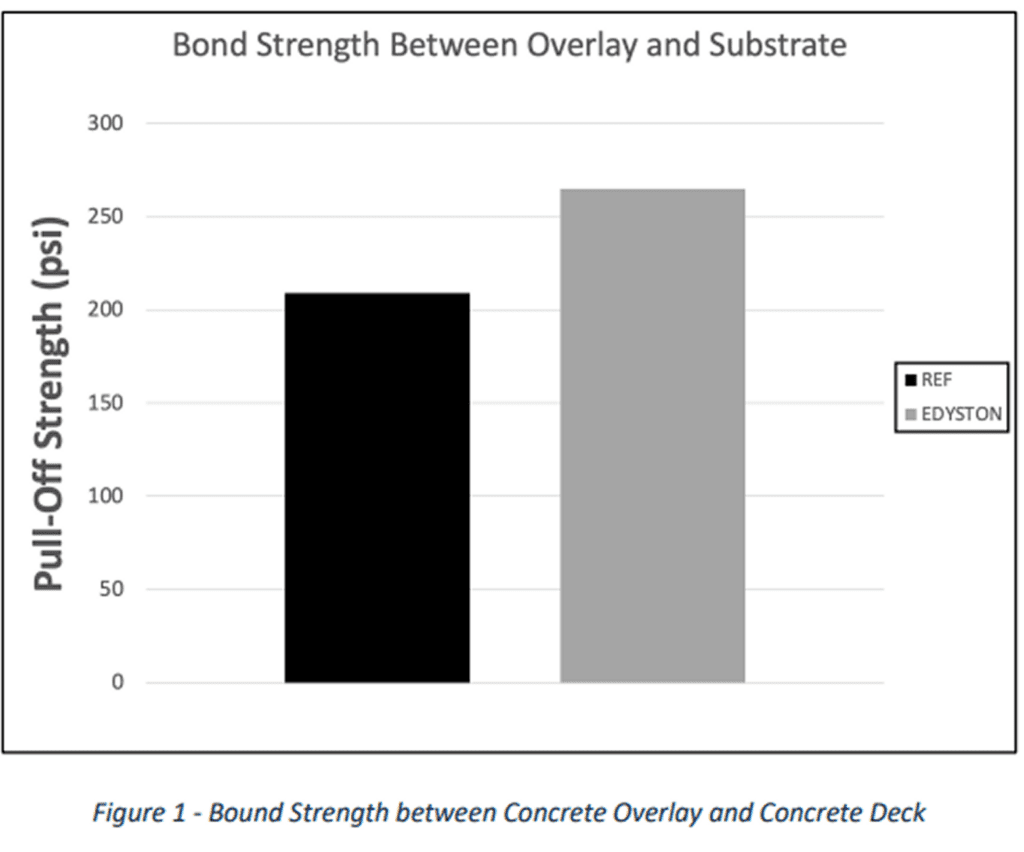
The application of the DENSYGEL after hydro-jetting and before the concrete increased the bond strength by over 25% as shown in Figure 1. Failure of both concrete samples (REF and EDYSTON) occurred in the concrete deck, Type A as show in Figure 2.
Microscopic Evaluation
The purpose of microscopic evaluation ranges was used to assessing overall quality, including constituent materials like aggregates, paste, and air-void structure. Further, this analysis is critical for understanding the interfacial zone’s (ITZs) behavior between a concrete overlay and substrate, especially when modified with DENSYGEL.
REFERENCE
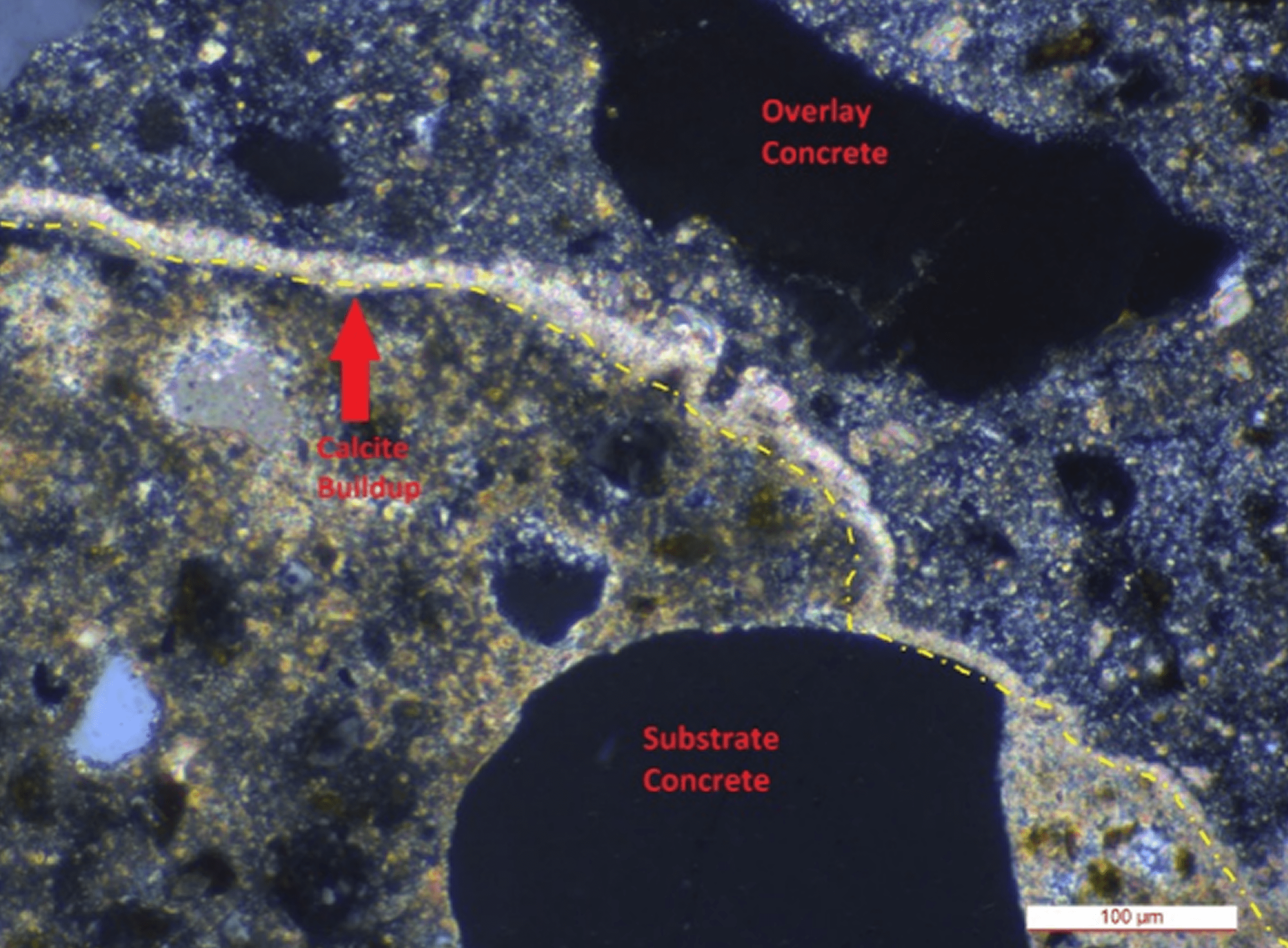
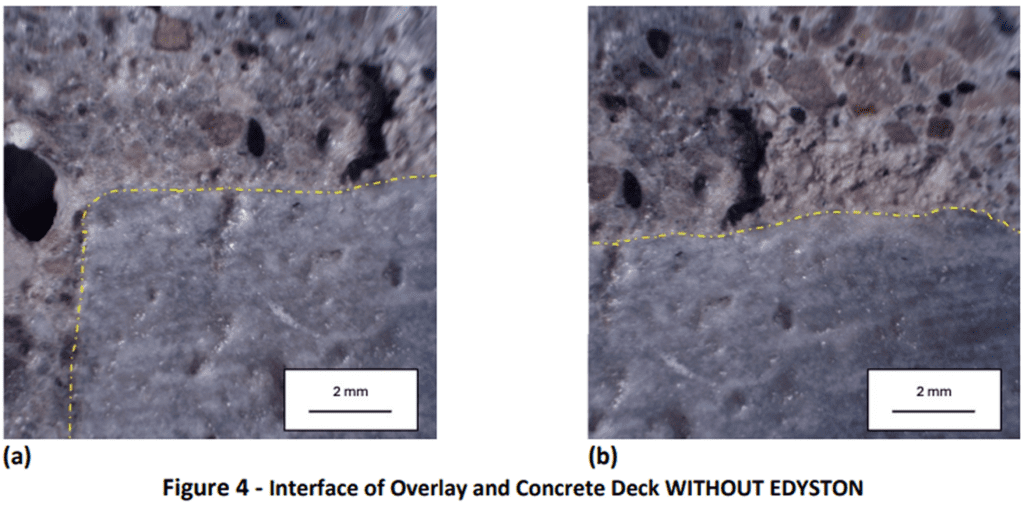
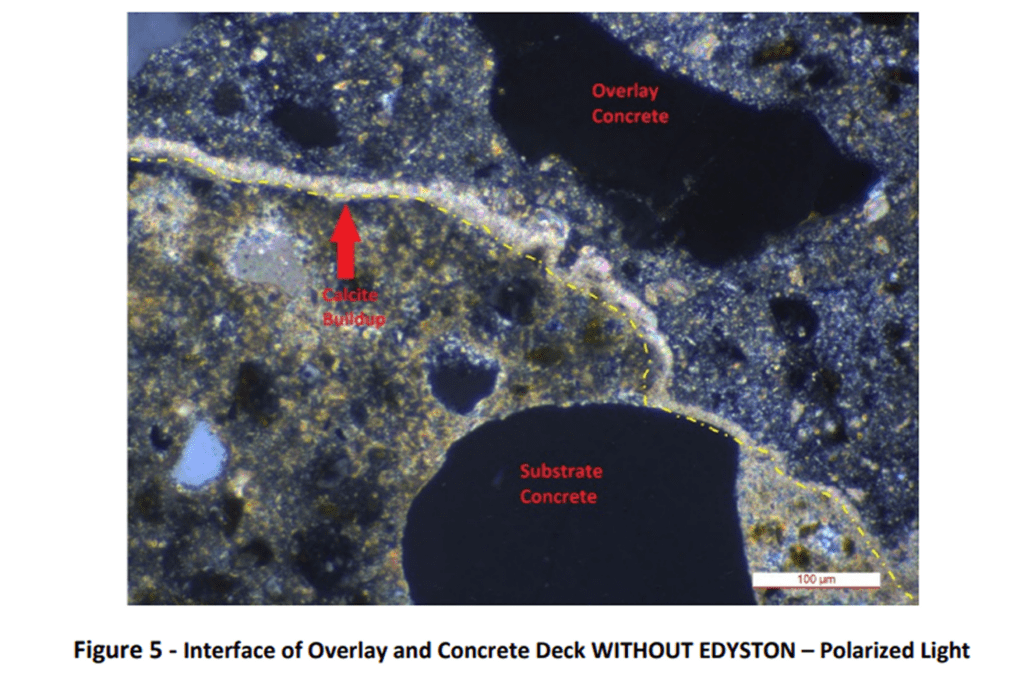
For the REFERENCE sample, the ITZ on either side shows two distinct sets of mixes. The overlay placed on top of the concrete substrate without the EDYSTON exhibited a porous ITZ, as illustrated in Figure 4(a-b) and Figure 5.
The yellow dashed line delineates the interface between the Overlay (OV- top) and the Concrete Deck (CD – bottom). At the center of both images, there is a 1 to 2-mm pore at the OV-CD interface. Adjacent to the pore, on the right, an area of deteriorated paste is observed.The presence of pores and deteriorated paste highlights a deficiency in the hydrated cementitious matrix at the interface. This lack of a cohesive paste layer compromises the interface bonding strength between the OV and the CD, rendering the system prone to early age deterioration and potential delamination. In the polarized image, Figure 5, a distinct layer of calcite has formed at the interfacial zone between the OV and the CD. This calcite deposition poses significant concerns for long-term bonding integrity and reduces resiliency against both physical and chemical degradation.
EDYSTON
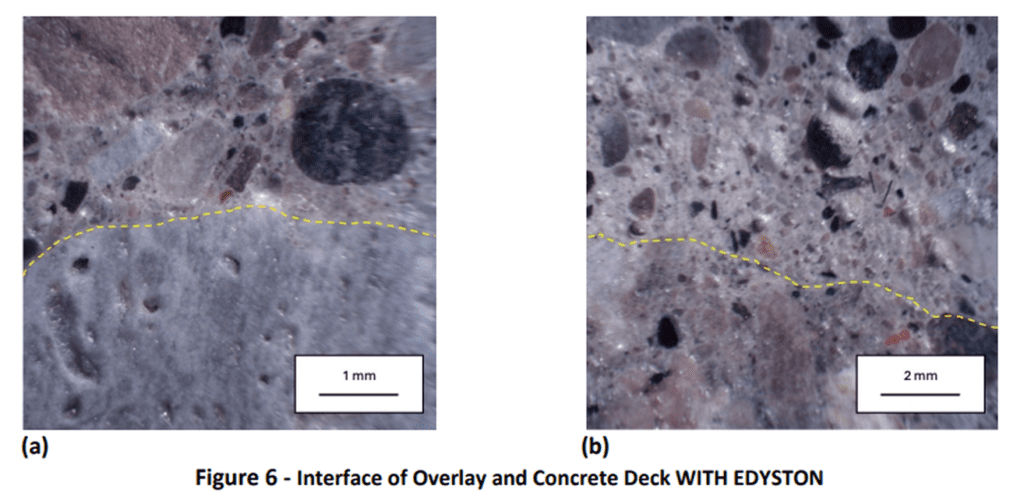
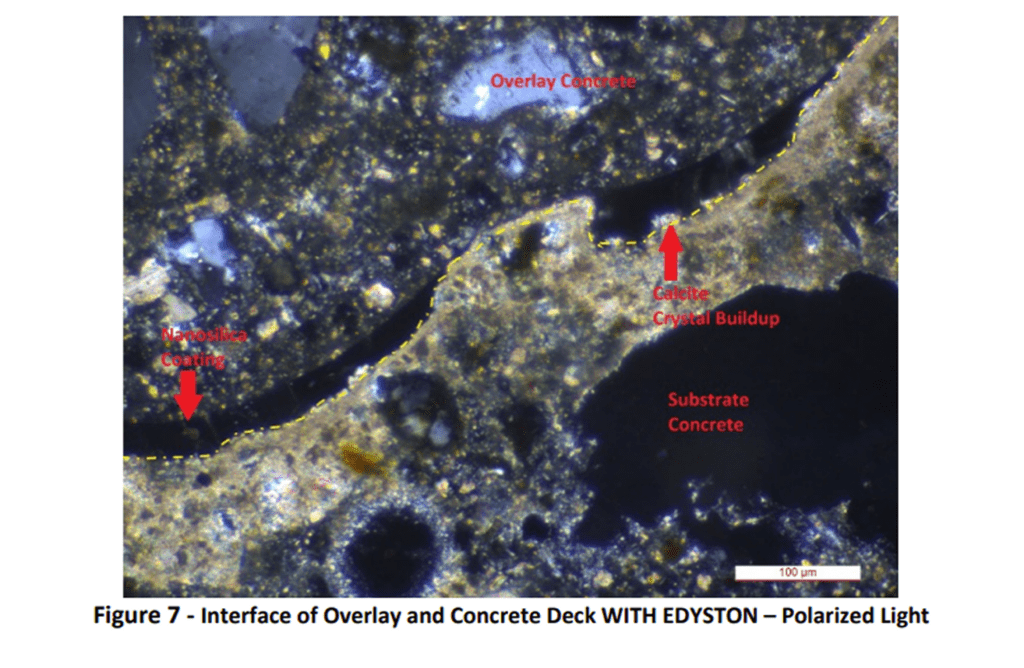
The overlay placed on top of the concrete substrate without the EDYSTON exhibited a more porous ITZ than with the EDYSTON treatment as illustrated in Figure 6(a-b) and Figure 7. The yellow dashed line delineates the interface between the Overlay (OV – top) and the Concrete Deck (CD bottom). The absence of pores and deterioration highlights the impact of the EDYSTON treatment to support the development of the hydrated cementitious matrix at the interface.
This cohesive paste layer enhances the interface, bond, and strength between the OV and the CD, increasing the concrete systems resiliency to physical and chemical attack. A near absence of the of calcite layer was observed at the interfacial zone between the OV and the CD. In the polarized image, the calcite layer has been replaced with the remnants of the EDSYTON colloidal silica based hydrogel.
Conclusion
The evaluation of the concrete overlay systems strongly demonstrates the impactful benefits of incorporating DENSYGEL into the interfacial application process. Results from ASTM C 1583 illustrated a 25% increase in bond strength when DENSYGEL was applied to the concrete deck. Microscopic evaluations further underscored the enhancements brought by DENSYGEL, showcasing a denser and more hydrated interfacial zone compared to the reference samples, which directly contributes to greater durability and cohesive integrity.
These findings affirm the role of DENSYGEL as a cutting-edge solution for improving performance and prolonging the lifespan of concrete infrastructure. By enhancing bond strength and ITZ properties, DENSYGEL can bring significant potential to increase concrete overlay efficiency and life-cycle.
Tags: