Sub-Total: $0.00

Abstract
As you make your way across Georgia, it’s easy to take for granted the thousands of bridges that provide passage over our roads. But a closer look reveals an alarming reality: 14,769 bridges are in place and 40% of them are 50 years old or older with an average age of 42.6 years – a statistic that should be worrying both engineers and construction contractors alike due to the potential risk these aging structures pose to public safety. With this in mind, it is more important than ever for those in the fields of engineering, contracting, lobbying and politics alike to come together on finding solutions that can help bring these aging structures up-to-date with modern regulations and safety standards while keeping repair costs sustainable without overextending budgets.
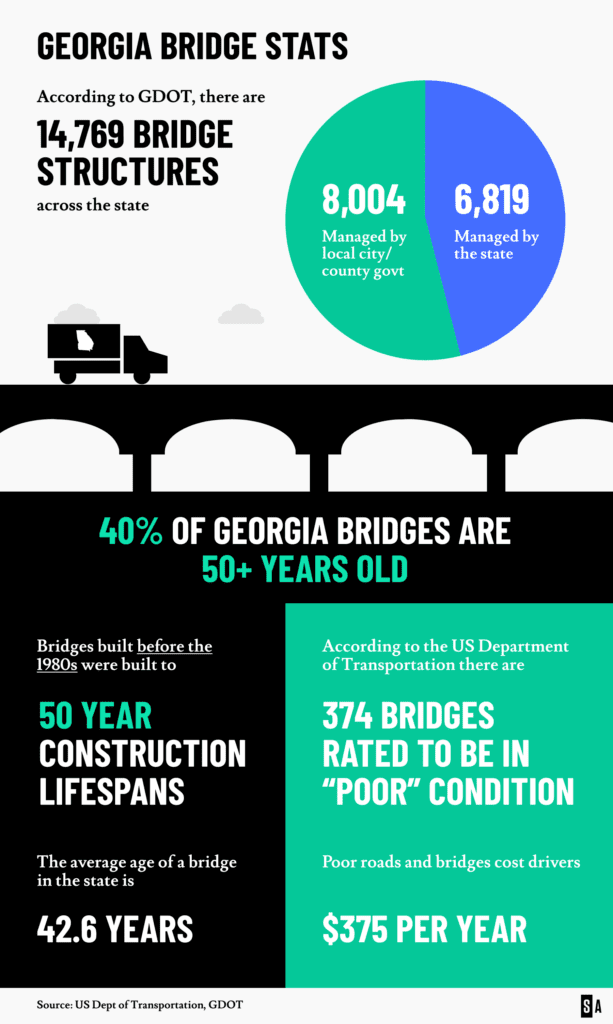
Georgia Bride Statistics (G-DOT 2023).
As you drive across the highways and roads of Georgia, you may not realize the sheer number of bridges you are crossing. An astounding 14,769 bridges are in place across the state, a statistic that is sure to capture the attention of any driver. But what is more concerning is that a staggering 40% of these bridges are 50 years old or greater, and the average age of all Georgia bridges is 42.6 years.
It is no secret that bridges are crucial infrastructure systems that ensure safe travel for commuters, commerce, and even emergency vehicles. However, for these systems to remain effective, they must undergo regular maintenance and repairs. In Georgia, the cost of maintaining and repairing all these deteriorating bridges can be a burden on drivers, amounting to a significant sum per year.
What if I told you that there is a way to increase the service life of these aged bridges and reduce the cost of maintenance and repairs? By implementing colloidal silica hydrogel technologies, like EDYSTON, we can rejuvenate these aged concrete bridges and extend their service life.
Bridges in Georgia that were constructed before the 1980s only had a 50-year lifespan. However, with recent advancements in technology, we can now use colloidal silica hydrogels as a means of repairing and treating concrete bridges, extending their life beyond 50 years.
EDYSTON is a state-of-the-art technology that can help restore the structures of these aged concrete bridges. This process involves the injection of a colloidal silica hydrogel to fill any voids, micro-cracks, and fractures, thus reducing the amount of water and other damaging elements that can penetrate the concrete. The result is a more durable bridge structure that can withstand harsh weather conditions and heavy traffic.
But the benefits do not stop there. By implementing EDYSTON and other colloidal silica hydrogel technologies across Georgia’s network of bridges, we can help reduce the cost of maintenance and repairs needed to keep these structures functioning safely. This is good news not only for drivers but also for taxpayers who are ultimately burdened with these costs.
Are we all set to replace every bridge in Georgia? Unfortunately, no. However, by utilizing advanced technologies like colloidal silica hydrogels, we can significantly increase the lifespan of these great engineering feats and keep them safe and reliable for years to come.
It is time we take action and invest in technologies like EDYSTON to maintain and repair Georgia’s aging concrete bridges. We owe it to ourselves and future generations to ensure the safety and longevity of our infrastructure systems.
Tags: